Whole Foods Approach

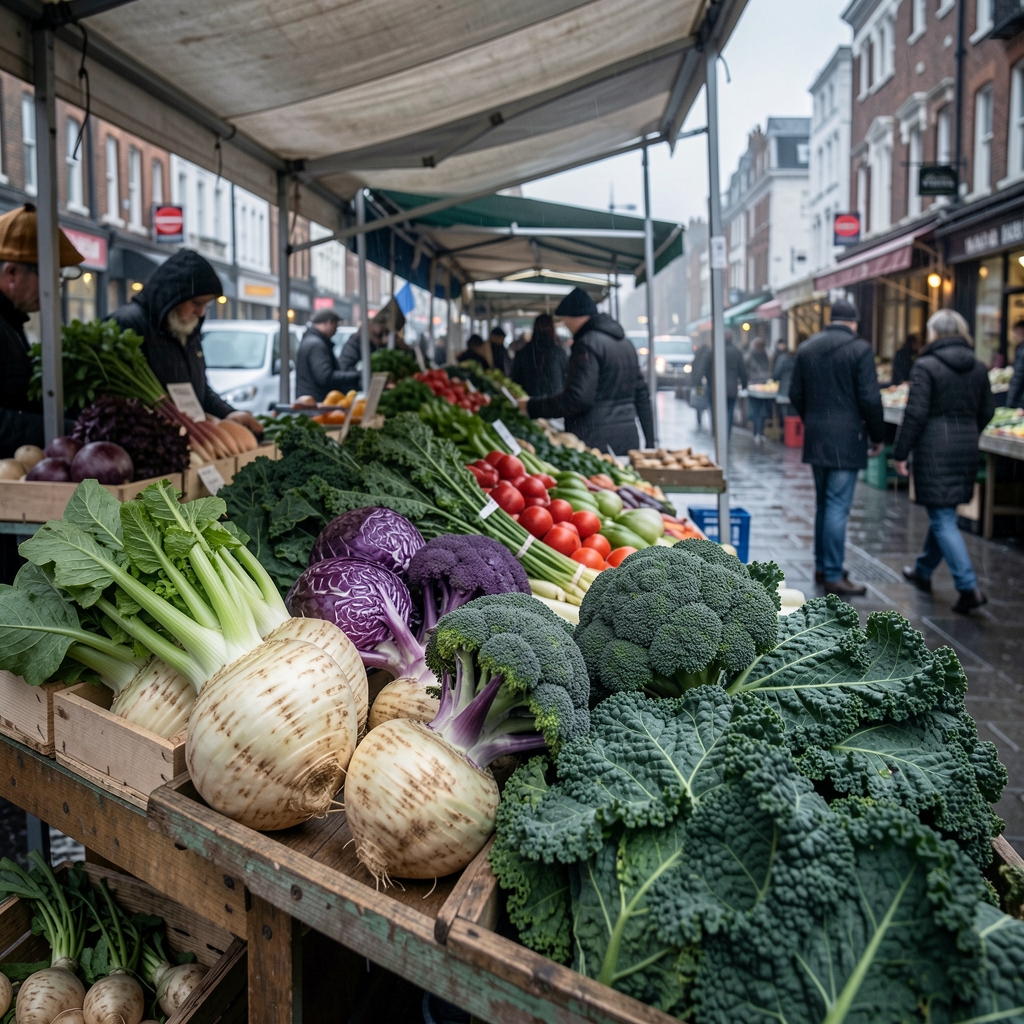
London's produce markets shift in composition across the calendar year in ways that are still more pronounced than the supermarket shelves suggest. Farmers' markets, greengrocers operating with local supply lines, and the vegetable boxes delivered from regional farms all reflect a sequence: root-heavy winters, brassica-dominant springs, abundant summers, and the condensed richness of autumn. Following this sequence — even loosely — introduces a pattern of dietary variety that operates without explicit nutritional planning.
Seasonal eating is sometimes framed as an aesthetic preference — a way of connecting to agricultural cycles, of cooking more interesting food, of supporting local producers. These are valid motivations. But the nutritional dimension is perhaps underexamined: the rotation of food types across the year produces, almost incidentally, a rotation of macronutrient ratios, fibre sources, and micronutrient profiles that no fixed dietary plan easily replicates.
Consider the contrast between winter and summer in a produce-led kitchen. Winter months in England bring celeriac, parsnips, swede, leeks, kale, Brussels sprouts, purple sprouting broccoli, stored apples, and citrus. These are predominantly root vegetables and brassicas: dense, fibre-rich, slow to cook, and filling in a way that lends itself to smaller portions. The dishes they produce — roasted roots, braised brassicas, thick soups — are nutritionally substantial and tend to produce sustained satiety.
Summer shifts the palette entirely. Courgettes, tomatoes, cucumber, salad leaves, peas, broad beans, new potatoes, berries, stone fruit, and herbs become the primary ingredients. These are higher in water content and lower in caloric density than their winter equivalents. The dishes they produce — salads, cold plates, light stews — are typically lighter in their satiety contribution, which summer appetites tend to align with anyway. The body's demand for dense, warming food tends to recede as ambient temperatures rise.
What the seasonal cycle produces, then, is a diet that oscillates between denser and lighter eating patterns across the year in rough proportion to the body's seasonal energy requirements. This alignment is not the result of planning — it is an emergent property of following what the land produces when.
The records reviewed for this article were contributed by three individuals following a loose seasonal eating approach in London between October 2025 and January 2026. None was following a defined programme; all were purchasing primarily from farmers' markets, a local greengrocer, and one weekly vegetable box subscription. The records included weekly food logs, subjective appetite ratings, and body weight observations taken each Monday morning.
October began with the tail end of summer produce — tomatoes, squash, courgettes — transitioning gradually into root vegetables and brassicas by November. The food logs across all three contributors showed a corresponding shift in meal composition: lighter, salad-adjacent meals in early October giving way to roasted and braised dishes by late November.
The weight observations across the four-month period were not uniform, but a broad pattern was visible: the transition into root-vegetable-dominant eating in November and December corresponded with steady, relatively stable weight across all three contributors, despite the general perception that the winter season prompts weight increase. Two of the three contributors noted a slight downward drift in weight during January, which coincided with the highest proportion of brassicas and citrus in their diets — the peak of the English winter vegetable season.
"The food of January is, in England, among the most nutritionally rigorous available: purple sprouting broccoli, cavolo nero, celeriac, blood oranges, forced rhubarb, stored apples. The kitchen in January is not the kitchen of deprivation. It is the kitchen of uncommon nutritional density."
One of the observations that emerged from the October-to-January records was how consistently the contributors underestimated the filling quality of root vegetables relative to their caloric content. A bowl of roasted parsnips, carrots, and celeriac dressed with a small amount of olive oil, herbs, and mustard is a nutritionally substantial serving. It provides significant fibre, a modest amount of natural sugar, vitamins, and the satiety contribution of slow digestion. Its caloric content is modest relative to its volume and filling quality.
This observation aligns with existing nutritional research on what is sometimes described as caloric density management: the principle that choosing foods with lower calorie-to-volume ratios produces a greater sense of fullness relative to caloric intake. Root vegetables perform well on this measure, alongside leafy greens and legumes. Their inclusion in winter cooking tends to produce meals that feel substantial without generating the energy surplus that dense winter cooking can otherwise produce.

The arrival of peak citrus season in January is nutritionally significant for a particular reason. Blood oranges, Seville oranges, clementines, and grapefruit arrive in volume precisely at the point in the year when daylight is at its lowest, cold and respiratory exposures are highest, and the micronutrient depletion of a long winter has been accumulating. The vitamin C content of citrus, combined with the flavonoids present particularly in blood oranges and Seville varieties, provides a micronutrient input that is structurally timed to the season of greatest demand.
The observation in the field records was less precise but directionally consistent: the contributors who included daily citrus — typically two to three pieces per day across January — reported notably higher energy and fewer episodes of low-energy afternoons compared with their own reports from December, when citrus consumption was lower. Whether this corresponds to vitamin C status specifically, or to the combined micronutrient profile of winter citrus more broadly, is not determinable from these records alone.
The transition from winter to spring produce in England — typically beginning in March with purple sprouting broccoli, watercress, early salad leaves, spring onions, and radishes — is experienced by seasonal eaters as a kind of appetite reset. The palate, accustomed to the richness of roasted roots and braised vegetables, responds distinctly to the freshness, slight bitterness, and high water content of early spring greens.
This transition tends to produce a natural reduction in portion size and meal density. Spring vegetables have different structural properties to winter vegetables: they require less cooking time (or none), they are less caloric per volume, and they tend to be served as parts of lighter, less constructed meals. The body's energy requirements are also shifting at this point: lighter clothing, more outdoor time, and longer days all contribute to a slight increase in general activity level compared with the sedentary months of January and February.
The contributors whose records extended into March all noted the same subjective experience: the arrival of spring produce felt, in their own words, like a release. Meals became lighter almost automatically. Appetite for dense, warming food receded. This is not a nutritional programme — it is the normal seasonal oscillation of appetite responding to environmental change, mediated by the foods that happen to be available.
The editorial team does not claim that seasonal eating is the single most important factor in weight awareness. It is one factor among several. But its particular quality — that it introduces dietary variety, caloric density management, and micronutrient rotation without explicit planning — makes it a structurally sound foundation for the kind of gradual, sustainable weight balance this publication observes and documents.

Tobias Marsden is a contributing writer and qualified nutrition professional at Elarovan Letters. His work focuses on the relationship between seasonal food availability, dietary variety, and gradual weight patterns. He maintains a weekly food journal and sources the majority of his produce from London farmers' markets and a local greengrocer in EC1.
More from the Publication →